Baldi's Basics® Classic
- 4.2
- Rating
- 50.00M
- Installs
- Free
- Price

 Analysis by App-foxy
Baldi’s Basics® Classic is the kind of strategy game I recommend with a warning attached: it looks simple, almost like a strange school-themed lesson, but its real strength is how quickly it turns ordinary movement and decision-making into pressure. I played it expecting a short novelty experience and found a game built around one central capability: using limited information to plan an escape while reacting to sudden danger. That focus gives it a personality that is very different from a conventional puzzle game or a standard horror title.
Developed by Basically, Games!, this free game belongs to the strategy category, although it borrows heavily from horror and parody. Its store summary describes it as the original version of a horror, edutainment parody game, and that combination explains the unusual tone. It presents a deliberately awkward school setting, then asks me to think clearly while the atmosphere becomes increasingly uncomfortable. The contrast is the point: the visuals and presentation can seem silly, but the decisions become serious once I am trying to reach safety.
The game is available for Everyone, and it runs on Android from version 5.1 onward. It has reached over ten million installs, with an average score of 4.2 from roughly two hundred thousand ratings. Those figures suggest that its strange presentation has found a broad audience, but they do not remove the need to understand what kind of experience it offers. This is not a relaxing educational tool, and it is not a long-form strategy campaign. It is a compact, repeatable challenge based on tension, observation, and learning from mistakes.
You May Also Like

 Pandora - Music & Podcasts
Pandora’s Music Is Easy to Start, but Harder to Recover
Pandora’s strength is its low-effort path from a seed to a station. Its weak spot is how much confidence it asks you to place in connection, setup, and quiet recovery.

 8 Ball Pool
 Is Built on Rivalries, Rematches, and Routine
A close look at the rivalries, rematches, shared routines, and unanswered safety questions that turn a quick pool match into a persistent mobile community.

 Samsung Music
’s Quiet Strength Is Playing What You Already Own
Its reach comes less from spectacle than from dependable access to a personal library. That simplicity is both the app’s strongest retention engine and its ceiling.

 AccuWeather: Weather Radar
AccuWeather Review: A Quick, Clear Forecast for Everyday Decisions
For everyday plans, the best forecast is the one you can understand quickly. AccuWeather makes rain timing, radar, and local conditions easy to act on, with a few trade-offs.

 Hill Climb Racing
Why Hill Climb Racing Still Turns Crashes Into One More Run
A tiny car, a bumpy hill and one more upgrade: Hill Climb Racing keeps resurfacing because its simple chaos makes every near-miss feel personal.

 AliExpress - Shopping App
AliExpress Makes Global Shopping Feel Personal, but Shoppers Bear the Risk
AliExpress turns a global marketplace into a pocket-sized discovery engine. Its reach is useful, its shopping loop compelling, and its trade-offs easy to miss.
More From Our News Desk
View All News


Planning an escape when every mistake changes the pressure
I look at this section as a closer look at how a run changes once the school stops feeling like a place to explore and starts feeling like a route I need to manage. The useful question is not only where to go, but which choices leave me room to recover when pressure rises. That way of thinking leads naturally into how progress becomes noticeable from one attempt to the next.
The capability that defines the experience
The most important feature here is not a large collection of mechanics. It is the way the game makes me plan under uncertainty. I enter the school with a straightforward objective, but the route is not simply a matter of walking from one marked point to another. I have to pay attention to where I am, remember useful locations, decide when to move quickly, and judge whether a detour is worth the risk.
That sounds familiar if you have played stealth or survival games, but Baldi’s Basics® Classic gives the idea a deliberately stripped-down form. There is no elaborate combat system to rescue a poor decision. I cannot solve every problem by overpowering it. Instead, the game keeps bringing me back to navigation and timing. A careless turn, a delayed choice, or an unnecessary visit to the wrong area can make the next part of the run much harder.
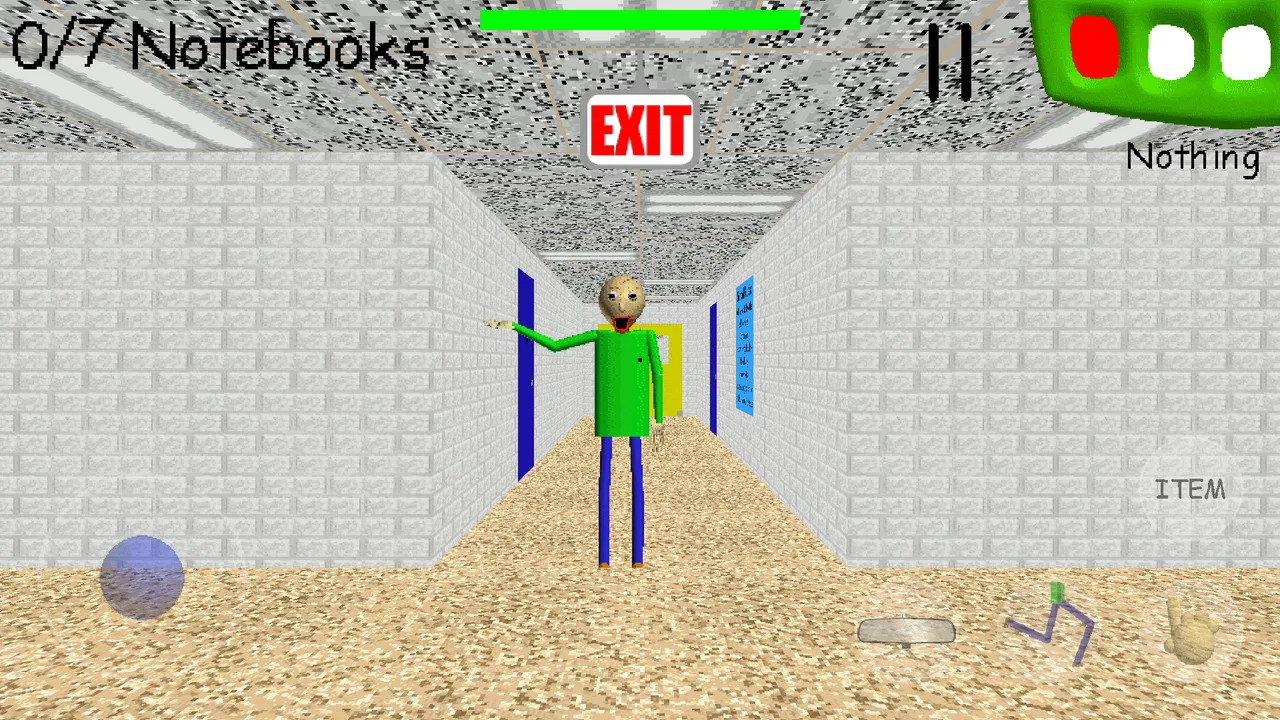
I found this design more strategic than the cartoon appearance suggests. The school is not just a backdrop for jokes. It becomes a space I need to read. I gradually build a mental map of routes and danger points, then try to use that knowledge more efficiently on the next attempt. The satisfaction comes from recognizing why a run failed and adjusting the plan, rather than simply hoping the next attempt will be luckier.
The key lesson is that information is more valuable than speed. Rushing may feel sensible when the game becomes threatening, but moving without a plan often creates a worse situation. I had better results when I used early moments to understand the layout and decide which paths I wanted to keep available. That makes the game a useful fit for players who enjoy learning through repetition instead of expecting a smooth first attempt.
How the pressure works in practice
In a typical session, I begin with a clear task and enough room to make choices. The opening can feel almost harmless because the setting looks intentionally basic and the objective appears manageable. That calm does not last. As I progress, the game asks me to balance exploration against the growing risk of being caught or forced into an inconvenient route.
What makes the process effective is the change in my attention. At first I look for the next objective. Later I start checking whether a corridor is safe, whether I am spending too long in one place, and whether the route I chose leaves me with a useful fallback. The game does not need complicated instructions to create this shift. The environment and the pursuit pressure do most of the work.
The educational parody also affects how I interpret mistakes. Problems are presented through a deliberately exaggerated school theme rather than a realistic horror setting. That keeps the mood odd instead of relentlessly grim, but it does not make failure meaningless. I still feel the cost of poor planning because the next attempt begins with more knowledge but also with the memory of what went wrong.
One practical tip helped me more than simply trying to move faster: I treated each early attempt as a mapping exercise. Instead of judging a run only by whether I escaped, I paid attention to the order of locations, the turns that seemed useful, and the moments when I lost control of the situation. This approach turned repeated failure into progress. It is especially helpful on a phone, where short sessions make it easy to restart and test a different route without committing to a long campaign.
Another useful habit is to avoid making every decision at the last possible moment. When the game becomes tense, I found it tempting to continue toward the nearest visible goal. That can be a trap in strategic terms. A slightly longer route may preserve more options, while a direct route can leave me cornered or unable to react. The game rewards players who think one or two moves ahead, even though the presentation encourages frantic reactions.
A realistic everyday scenario
I can see this working well during a short break when I want something more demanding than an idle game but do not have time for a long story. I might play one attempt while waiting for an appointment, fail because I misunderstood a route, then return later with a clearer plan. The compact structure makes that practical. I do not need to remember a complex plot or rebuild a large inventory before trying again.
The same situation also shows the main limitation. This is not a game I would choose when I want to relax with predictable progress. A short session can become surprisingly tense, especially if I am already tired or easily frustrated by repetition. The unusual humor may make the experience entertaining for one player and irritating for another. Its value depends on enjoying the process of being challenged, not merely reaching an ending.
Where it differs from ordinary strategy games
Compared with a traditional strategy game, this one has less emphasis on building, collecting, managing resources, or developing a long-term system. I am not optimizing a settlement or arranging a large group of units. The strategy is personal and immediate: where I go, when I commit to a route, and how well I remember the environment.
Compared with a typical horror game, it is less interested in cinematic storytelling and realistic fear. The parody style makes the threat strange and sometimes funny. That does not eliminate tension; instead, it creates an uncomfortable contrast between childish presentation and the need to stay alert. Players who want a serious narrative horror experience may prefer a different game, while players who find conventional horror too heavy may appreciate this more playful approach.
It also differs from a standard puzzle game. A puzzle usually gives me a contained problem that I can inspect until I find the answer. Here, solving one problem does not make the whole situation safe. I still need to move, observe, and adapt. That means the game is better for someone who likes puzzles combined with pursuit and uncertainty than for someone who wants quiet, purely logical challenges.
The tradeoff between repetition and mastery
The biggest tradeoff is simple: the game becomes more interesting as I learn, but that learning comes through repeated attempts. The first run can feel confusing because I am discovering the environment and the consequences of my choices at the same time. Later runs are more satisfying because I understand what I am trying to do, yet the experience can lose its appeal if I do not enjoy revisiting the same challenge.
I would not describe this as a flaw that affects everyone equally. For me, repetition worked when I had a specific question to answer: Was that route actually safer? Should I have explored earlier? Did I waste time by reacting instead of planning? Each attempt had a purpose. Without that mindset, restarting can feel like going in circles.
The controls and presentation are intentionally uncomplicated, which helps the game remain approachable. At the same time, the simple style does not mean every moment feels comfortable on a small touchscreen. Under pressure, a quick movement or turn can feel less precise than it would with a physical controller. I learned to make deliberate inputs rather than constantly dragging or changing direction. Players who dislike mobile controls during tense sequences should keep that limitation in mind.
The free price makes experimenting easy, especially for someone curious about unusual indie-style games. I can try it without treating the download as a major commitment. Still, free access does not make the design universally suitable. The game asks for patience, attention, and a willingness to fail. Someone looking for a polished, content-heavy strategy package may find the deliberately rough presentation too narrow.
Who benefits most from this design
I think the strongest audience is made up of players who enjoy short horror experiences, unusual parody, and strategy based on memory. It is also a good choice for people who like watching themselves improve through route planning. The game gives me a reason to notice small decisions, and the school setting makes those decisions easier to remember than they might be in a generic maze.
It can be a fun choice for friends who enjoy comparing reactions, even though the core experience is still about my own decisions. One person may focus on the humor, another may study the safest route, and a third may simply enjoy the tension of seeing how long a run lasts. That variety comes from the same central capability: the game turns a familiar-looking environment into a problem of judgment.
I would suggest skipping it if you want a calm educational app, a deep management strategy game, or a horror story with extensive character development. The word “edutainment” in its description should not lead anyone to expect lessons in a conventional sense. The school theme is part of the parody and challenge, not a replacement for a classroom tool.
I would also be cautious about recommending it to younger players who are sensitive to pursuit or unsettling audio-visual surprises, even though its official age category is Everyone. The presentation is cartoonish, but the game is still designed to create alarm. Age labels are useful guidance, yet personal tolerance matters more here than the bright, simple look might suggest.
Small habits that make each attempt more useful
My first recommendation is to separate discovery runs from serious escape attempts. During discovery, I deliberately observe the layout and accept that the run may end early. During a serious attempt, I use that knowledge instead of stopping repeatedly to investigate every possibility. This reduces wasted movement and makes the game feel less random.
Second, I try to preserve options. If two routes seem possible, I do not automatically choose the shortest one. I consider which path gives me more room to change direction if the situation worsens. That is a subtle but important difference between merely knowing the map and actually using it strategically.
Third, I avoid judging the game by the opening minutes alone. The parody can make it seem like a joke app at first, but the challenge becomes clearer once I have to make decisions while under pressure. Conversely, I also avoid assuming that a difficult run means I need to play faster. In my experience, better preparation usually mattered more than frantic movement.
These habits answer a question many new players have: should I keep trying after an early failure? Yes, if I can identify one concrete lesson from the attempt. No, if I am already annoyed by repeating the same route without changing my approach. The game is most rewarding when each restart is an experiment rather than a punishment.
Device expectations and the current edition
The Android release is free and supports devices using Android 5.1 or later. Its current version is 1.4.5, and the broad install history suggests that it is not aimed only at people with the newest phones. Even so, the practical experience will depend on the device, screen size, and how comfortable I am with touch movement during stressful moments.
I would install it when I want a compact, distinctive strategy game rather than a large download that demands a long-term commitment. The free entry point is particularly useful for deciding whether the humor and repetition suit me. If I find myself enjoying the process of memorizing routes and managing pressure, it can provide plenty of replay value. If I need constant new stages or a strong story to maintain interest, the central loop may feel too focused.
My recommendation after playing
Baldi’s Basics® Classic succeeds because it commits to one unusual idea: make navigation and planning feel threatening inside a deliberately silly school parody. I enjoyed the way a simple-looking setting gradually became a mental map, and I liked that improvement came from paying attention rather than collecting upgrades or relying on a complicated system.
Its rough humor, repeated attempts, and touch-based pressure will not suit everyone. I would choose another strategy game for deep management, another horror game for serious storytelling, and another educational app for genuine instruction. But if you want a free mobile experience that combines odd comedy with route planning and tense decision-making, this is an easy one to try.
My final advice is to approach it as a game of learning, not a race to win immediately. Give yourself one attempt to understand the space, one to test a safer plan, and then decide whether the pressure is enjoyable. For the right player, that simple cycle turns a bizarre parody into a surprisingly effective strategy challenge.
FAQs for Baldi's Basics® Classic
01What is the main objective of Baldi's Basics® Classic?
Baldi's Basics® Classic is a unique indie horror game with an educational twist. The primary objective is to explore a seemingly normal school environment to collect seven notebooks while avoiding Baldi, the eccentric teacher. Players must solve math problems to progress, but incorrect answers lead to increased difficulty and Baldi becoming more aggressive.
02Is Baldi's Basics® Classic suitable for children?
While the game has a cartoonish appearance, it's important to note that Baldi's Basics® Classic is a horror game designed to be creepy and intense. It features jump scares and a tense atmosphere, which may not be suitable for younger children. Parental discretion is advised, especially for those sensitive to horror elements.
03What platforms is Baldi's Basics® Classic available on?
Baldi's Basics® Classic is available for download on Android and iOS devices. It can be found on the Google Play Store and Apple App Store. Additionally, there is a version available for PC, which can be downloaded from various online platforms. Always ensure you download from official sources to avoid malware.
04Does Baldi's Basics® Classic require an internet connection to play?
No, Baldi's Basics® Classic does not require an internet connection to play. The game is designed to be fully functional offline, making it a great option for those looking to enjoy a unique horror experience without relying on Wi-Fi or mobile data. However, an internet connection may be needed for updates.
05Are there any in-app purchases or ads in Baldi's Basics® Classic?
Baldi's Basics® Classic is a free-to-play game that may include ads. While there are no mandatory in-app purchases to progress, some optional purchases might enhance the gaming experience or remove ads. Always check the app’s description and settings to manage these features according to your preferences.
Pros
- Unique horror-education blend.
- Simple controls enhance gameplay.
- Nostalgic graphics style.
- Challenging puzzles and tasks.
- Free to download and play.
Cons
- Graphics may feel outdated.
- Limited game levels available.
- Can be repetitive over time.
- Ads can interrupt gameplay.
- Might be too scary for kids.

Baldi's Basics® Classic
Gallery